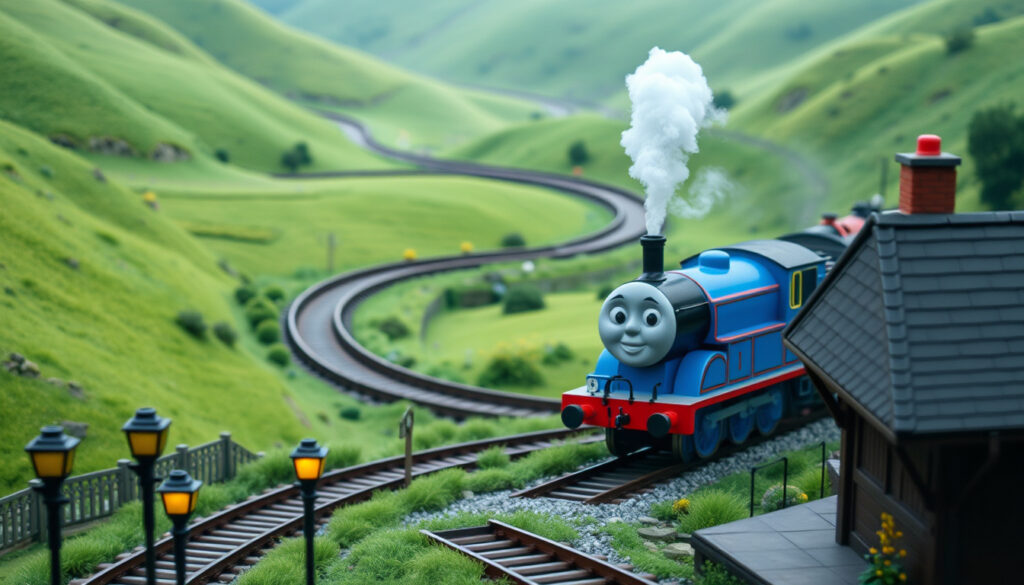
Thomas the Tank Engine – History, Characters, Episodes and Toys
Thomas the Tank Engine, formally known as Thomas & Friends, stands as one of the most enduring children’s franchises in entertainment history. Centered on anthropomorphic steam locomotives living on the fictional Island of Sodor, the series has captivated young audiences since its inception. From humble beginnings as bedtime stories told by a clergyman to his son, the franchise has grown into a global phenomenon spanning books, television, films, and extensive merchandise lines.
The series centers on Thomas, a cheerful blue tank engine, and his fellow locomotives, each possessing distinct personalities ranging from the pomposity of Gordon to the cheekiness of Percy. These engines work under the watchful eye of Sir Topham Hatt, known affectionately as “the Fat Controller,” who manages the North Western Railway. The stories teach children valuable lessons about friendship, cooperation, and perseverance through engaging railway adventures.
Over more than seven decades, the franchise has evolved significantly while maintaining its core educational values. What began as hand-drawn illustrations accompanying moral tales has transformed through multiple production eras, including live-action model animation and modern computer-generated imagery. Today, Thomas & Friends continues entertaining preschoolers worldwide while honoring the vision of its original creator.
What is Thomas the Tank Engine?
Thomas the Tank Engine represents a children’s media franchise that began with The Railway Series books authored by Rev. W. Awdry and expanded into the beloved television series Thomas & Friends. The franchise centers on the adventures of sentient steam locomotives operating on the Island of Sodor, a fictional island positioned between England’s Lake District and the Isle of Man.
Overview of the Franchise
Setting on the Island of Sodor
The fictional island of Sodor serves as the exclusive setting for the franchise’s stories. Awdry based this location partially on his 1950 visit to the Isle of Man and drew inspiration from the historical Diocese of Sodor and Man, whose name derives from the Norse term Sudreyjar meaning “southern isles.” The island exists in a state of narrative isolation from British Railways, allowing for complete creative control over its railway systems and operations.
Key locations on Sodor include Tidmouth, Wellsworth, Maron, Cronk, and Vickers Town. The North Western Railway connects these towns, with additional narrow-gauge railways serving mountain regions.
- Over 700 television episodes produced across multiple production eras
- The Railway Series encompasses more than 75 books published since 1945
- Franchise translated into numerous languages for international markets
- Characters based loosely on real British railway engine prototypes
- Detailed world-building includes fictional newspapers and historical events
- Merchandise sales have generated billions of dollars worldwide
| Aspect | Details |
|---|---|
| Books | The Railway Series (1945–2011) |
| TV Seasons | 24 seasons plus specials |
| Primary Railway | North Western Railway |
| Theme Motto | “Really Useful Engine” |
| Management | Sir Topham Hatt (The Fat Controller) |
| Setting | Fictional Island of Sodor, Irish Sea |
Who Created Thomas the Tank Engine?
The creative force behind Thomas the Tank Engine was Rev. Wilbert Awdry, an English clergyman and passionate railway enthusiast. Born in 1911, Awdry developed his storytelling abilities during his time serving in railway administration before entering the clergy. His unique combination of religious dedication and childhood fascination with locomotives created the foundation for one of children’s literature’s most successful franchises.
Rev. W. Awdry’s Background
Awdry invented the original characters in 1943 while caring for his son Christopher, who was recovering from measles. The young boy, confined to bed and bored during his illness, requested stories about trains. What began as improvised tales featuring engines named Edward, Gordon, and Henry eventually formed the basis of The Railway Series. Awdry initially told these stories orally before recording them, eventually publishing the first volume when Christopher recovered.
Awdry’s storytelling incorporated elements from actual British railway operations, including references to real engine types and railway practices. This authenticity contributed significantly to the series’ educational value and lasting appeal.
First Publication in 1945
The first book, The Three Railway Engines, was published in 1945, introducing readers to Edward, Henry, and Gordon. Thomas himself did not appear until the second book, Thomas the Tank Engine, where he was described as a “cheeky little engine” who wished to pull his own train rather than work as a shunting engine. The series expanded to 26 volumes authored by Awdry himself, spanning publication through 1972. Following his retirement, his son Christopher Awdry continued writing additional Railway Series books.
Awdry maintained detailed attention to consistency throughout the series, creating maps and historical records for Sodor that addressed discrepancies and established firm canon. The 1958 folding map published by Edmund Ward showed locations of various engine mishaps, including James’s derailment and Percy falling into the sea. These materials became collectible items themselves, with early maps commanding significant prices among dedicated fans.
Who Are the Main Characters in Thomas the Tank Engine?
The Thomas & Friends universe features a diverse cast of locomotive characters, each designed with distinct personalities that appeal to young children. The engines’ anthropomorphic qualities allow them to express emotions, make mistakes, learn lessons, and develop relationships, creating relatable narratives for preschool audiences. Beyond the trains themselves, human characters provide additional dimension to the stories.
Thomas and His Friends
Thomas serves as the series’ protagonist, depicted as a bright blue tank engine with a cheerful disposition who works primarily on the branch line. His adventures frequently involve learning responsibility and cooperation while navigating the challenges of railway work. The main cast includes James, a red engine known for causing mishaps due to his eagerness; Percy, a small green engine who sometimes acts cheekily but means well; and Gordon, the largest and fastest engine who occasionally struggles with pomposity.
Other notable engines include Edward, a kind and patient veteran who offers wisdom to younger engines; Henry, who suffered from boiler illness before being rebuilt into a stronger engine; Toby, a tram engine with weathered looks; and Donald and Douglas, Scottish twin engines who originally worked on the Arlesburgh Railway. Narrow-gauge engines like Culdee operate on mountain railways, while supporting characters include Terence the Tractor and Bertie the Bus, who occasionally compete with the engines in friendly rivalry.
Throughout the series, engines undergo personality growth while maintaining consistent core traits. This approach allows young viewers to anticipate character behavior while appreciating gradual development over time.
Key Human Characters
Sir Topham Hatt, affectionately called “the Fat Controller” by generations of fans, serves as the primary human authority figure in the series. As controller of the North Western Railway, he assigns tasks, resolves disputes between engines, and delivers moral lessons when engines misbehave. His leadership style balances authority with fairness, modeling positive adult behavior for young viewers.
Supporting human characters include the Thin Controller, who manages the Little Western Railway; various station masters and workers throughout Sodor; and the railway inspector who ensures safe operations. These human roles provide context for the engines’ work and reinforce themes of community cooperation that extend beyond the locomotives themselves.
Thomas the Tank Engine TV Series and Episodes
The television adaptation of Thomas the Tank Engine began in 1984, bringing the beloved Railway Series stories to a broader audience through animated storytelling. Initially produced using live-action model trains filmed at studios in Bristol, the series employed meticulous techniques to create realistic miniature railways before transitioning to computer-generated imagery decades later.
Seasons and Production History
The original Thomas & Friends series ran for 24 seasons between 1984 and 2021, with production passing through several companies. Clearwater Features handled early seasons using the model animation technique, creating the distinctive aesthetic that many fans consider the series’ golden age. The production quality remained consistent throughout the model’s years, with each episode typically running approximately five minutes during the program’s early format.
In 2009, the series transitioned to CGI animation under the title Thomas & Friends: The Great Discovery, marking a significant visual shift for the franchise. This change allowed for more dynamic camera movements, elaborate sequences, and complex storylines that would have been difficult to achieve with physical models. The CGI era introduced new characters and expanded existing storylines while maintaining the educational focus that characterized earlier episodes.
Current Availability
The original model series and the CGI seasons remain available through various streaming platforms and home video releases. In 2021, the franchise underwent another transformation with the introduction of Thomas & Friends: All Engines Go, a reboot produced in collaboration with Mattel Creations. This new series employs a simplified CGI style and faster-paced storytelling designed specifically for preschool audiences, featuring shortened episode formats and musical elements.
Episodes are available through major streaming services, the official Thomas & Friends website, and home video releases. The franchise maintains an active YouTube presence with official uploads and behind-the-scenes content.
Thomas the Tank Engine Toys and Merchandise
Merchandise has played a central role in the Thomas & Friends franchise since its early years, with toys, games, and collectibles becoming integral to the brand’s identity. The range of products spans from basic wooden train sets to elaborate electronic playsets, allowing children to recreate the adventures they witness in books and on television.
Popular Toy Lines
Mattel, which acquired the franchise through its purchase of HIT Entertainment in 2011, produces the primary toy lines associated with Thomas & Friends. The Wooden Railway line represents one of the most recognizable product ranges, featuring scaled wooden replicas of engines and carriages that connect magnetically. These sets include tracks, bridges, stations, and various accessories that enable creative play scenarios.
The Take-n-Play line offers die-cast metal engines designed for portable play, compatible with various track configurations and playsets. Motorized train sets provide another popular option, featuring battery-powered engines that can pull multiple carriages along plastic track. Collectible series, including battery-powered models and special edition releases, appeal to dedicated fans and adult collectors.
Recommended Age Groups
Thomas & Friends products target children from toddler age through the early elementary years, with specific items designed for different developmental stages. The franchise primarily serves preschool audiences, typically children ages two through seven, aligning with the television program’s target demographic.
Most toys carry age recommendations ranging from 12 months to 5 years, with variations based on small parts, electronic components, or complexity of assembly. Parents can find age-appropriate options across all product categories, from simple wooden engines suitable for young toddlers to elaborate motorized sets designed for older preschoolers.
Key Milestones in Thomas the Tank Engine History
- – The Three Railway Engines becomes the first Railway Series book published
- – Edmund Ward publishes the first pictorial map of Sodor
- – Rev. W. Awdry concludes his Railway Series authorship
- – Thomas & Friends annual publications begin
- – Television series premieres using live-action model animation
- – Series transitions to computer-generated imagery
- – Mattel acquires franchise through HIT Entertainment purchase
- – All Engines Go reboot launches with new animation style
What We Know and What Remains Uncertain
| Established Information | Elements Requiring Clarification |
|---|---|
| Awdry created characters in 1943 for his son | Specific details about early unpublished stories |
| First book published in 1945 | Exact timeline of story development before publication |
| Mattel acquired rights in 2011 | Future creative direction remains subject to change |
| Series adapted books from The Railway Series | Specific production decisions and their reasoning |
| Sodor inspired by Isle of Man visit | Full extent of specific real-world railway influences |
| Original series ran 1984–2021 | Long-term streaming availability across platforms |
The Cultural Significance of Thomas the Tank Engine
Thomas the Tank Engine occupies a unique position in children’s entertainment, representing a bridge between traditional storytelling values and modern educational media. The franchise succeeded in introducing generations of children to concepts of friendship, responsibility, and perseverance through narratives that resonated on emotional levels despite featuring inanimate objects as protagonists.
The series contributed significantly to children’s understanding of railways and transportation, sparking interest in real-world railway history among countless young viewers. Many adults who grew up with the franchise maintain fond memories and occasionally introduce their own children to the series, creating multi-generational connections that strengthen the brand’s cultural relevance.
Fan communities have formed around the franchise, discussing canonical details, producing fan fiction and artwork, and maintaining databases of episode information and merchandise releases. These communities preserve institutional knowledge about the series while providing feedback that occasionally influences creative decisions. The level of fan engagement demonstrates the franchise’s lasting impact on popular culture.
Sources and Perspectives
“Every engine was known by their number. That was how Awdry organized his railway system, giving each locomotive a unique identity that reflected British railway traditions.”
— Analysis of The Railway Series literary structure
Primary sources for information about the franchise include the published Railway Series books, official Mattel press releases, and interviews with members of the Awdry family. The official Thomas & Friends website provides current information about series developments, merchandise releases, and streaming availability. Fan-maintained resources like the Sodor Island fan wiki offer detailed chronologies and episode guides that supplement official information.
- The Railway Series books by Rev. W. Awdry and Christopher Awdry
- Official Thomas & Friends media releases and website
- Published reference materials including The Island of Sodor: Its People, History and Railways
- Production records and behind-the-scenes documentation
Summary and Continuing Evolution
Thomas the Tank Engine evolved from a clergyman’s bedside stories into a global entertainment phenomenon that has shaped childhood experiences for nearly eight decades. The franchise’s success stems from its ability to combine engaging character-driven narratives with meaningful lessons about cooperation, responsibility, and personal growth. Through multiple iterations, from book pages to model trains to CGI animation, the essential appeal of Thomas and his friends has remained consistent.
The acquisition by Mattel and subsequent reboots reflect the franchise’s ongoing adaptation to changing media landscapes and audience expectations. While some longtime fans express preferences for earlier iterations, the current All Engines Go series maintains the core elements that have defined the franchise while introducing elements designed for contemporary preschool audiences.
For those exploring similar character-driven children’s franchises, Sally Nightmare Before Christmas – Complete Character Guide offers insights into another long-running property with dedicated fan communities. Understanding how different franchises engage young audiences provides perspective on the unique qualities that have sustained Thomas the Tank Engine’s popularity across generations.
What age group is Thomas the Tank Engine appropriate for?
Thomas & Friends primarily targets preschool children ages two through seven. Different product lines and episodes offer varying complexity levels, with most toys carrying age recommendations between 12 months and five years.
Is Thomas the Tank Engine still being produced?
Yes. The franchise continues with All Engines Go, a CGI-animated reboot that premiered in 2021. New episodes, merchandise, and streaming content are regularly released under Mattel’s ownership.
How many books are in The Railway Series?
Rev. W. Awdry authored 26 volumes in The Railway Series between 1945 and 1972. His son Christopher continued the series, bringing the total to over 40 books. Additional special volumes and reference books have also been published.
What controversies have surrounded the franchise?
No major controversies have affected the franchise’s reputation. Some fans have noted concerns about canon changes and the simplified approach of the All Engines Go reboot, but these represent typical franchise evolution discussions rather than substantive issues.
Where can I watch Thomas the Tank Engine episodes?
Episodes are available through major streaming platforms, the official Thomas & Friends website, and home video releases. The YouTube channel also features official uploads and clips from various series eras.
What is Sir Topham Hatt’s role?
Sir Topham Hatt, known as the Fat Controller, manages the North Western Railway on Sodor. He assigns tasks to engines, resolves conflicts, and ensures the railway operates efficiently, serving as the primary human authority figure throughout the series.
How many seasons of Thomas & Friends exist?
The original Thomas & Friends series ran for 24 seasons between 1984 and 2021. The All Engines Go reboot, considered a separate series, began airing in 2021 and continues production.
What toys are available for Thomas the Tank Engine?
Mattel produces several toy lines including Wooden Railway sets, Take-n-Play die-cast engines, motorized train sets, and various playsets. Collectible series and special edition releases appeal to dedicated fans and collectors.
Who owns Thomas the Tank Engine now?
Mattel acquired the Thomas & Friends intellectual property in 2011 through its purchase of HIT Entertainment, which had itself acquired the franchise earlier. Mattel Creations continues producing television content, toys, and related merchandise.
What makes Thomas the Tank Engine culturally significant?
The franchise represents one of the most successful children’s properties in entertainment history, spanning multiple media formats and generations of fans. Its combination of educational content, memorable characters, and consistent storytelling has created lasting cultural impact.
More related posts
 NBA Free Agents 2025 – Top Names, Timeline, Cap Space Guide
 American Horror Story Seasons in Order (Full List) – 2024 Guide
 What Does AD Stand For – Meaning, BC Comparison and History
 Corey Gamble: Net Worth, Career, Relationship with Kris Jenner
 Universal Studios Hollywood Tickets – 2025 Prices and Deals
 Canada PM Industry Announcement: Carney’s Defence Strategy
 Pocketmemories Net Blog: Family Travel Tips & Guide
 Harry Potter and the Order of the Phoenix: Plot, Cast & Rankings
